
Analysts expect modest recovery in Indian economy.

Soon after RBI announcing a much- awaited rate cut, Chief Economic Advisor Arvind Subramanian on Wednesday said that the global rating agencies should look at upgrading their stance on India's credit outlook. "Now we have a 50 basis points rate cut (in two tranches within two months) and I think that is good for the economy and all rate cuts benefits... If the outlook is looking good, the rating agencies should draw their lessons from that om improving the outlook," Subramanian told reporters. After presentation of Union Budget 2015-16 last week, global and domestic agencies had ruled out any immediate upgrade in India's sovereign ratings and had red-flagged the country's delayed fiscal consolidation roadmap and had also warned against any slippages from the "ambitious" disinvestment plan proposed in Budget. Subramanian said that the rate cut is consistent with the government's views in the last week's Economic Survey and thereafter in the Union Budget for the outlook on inflation and for the outlook on overall economy. "It (rate cut) shows that RBI and government are on the same page in terms of how we view the economy. It also means that Budget can be seen as conducive to non-inflationary growth," he added. On monetary policy framework agreement, Subramanian said that both Finance Ministry and RBI have shared concern about inflation. Recently, the Finance Ministry and the Reserve Bank agreed to 'inflation rate targeting' under which the apex bank will aim to lower retail inflation to below 6 per cent by January 2016.

At present, Indian indices are under-performing as compared to others and a package from the government can help cover the ground.

India's external firewalls were solid in the form of a healthy reserve position.

While foreign currency rating was retained at Baa2 -- the second-lowest investment grade score -- Moody's also projected a fiscal deficit of 3.7 per cent of gross domestic product in the year through March 2020, a breach of the government's target of 3.3 per cent.

PS banks need to pull up their socks to improve cash flows.

Yashwant Sinha explains where the Modi government has gone wrong in its handling of the economy.

He noted that the Rupee has firmed recently but cautioned that the currency should not lose its competitiveness in global trade.

The Indian government and RBI must keep foreign equity investors happy and avoid crushing growth expectations, notes Akash Prakash.

The central bank has been intervening in the foreign exchange market by buying dollars, and this is capping the rupee's gains.

As the Reserve Bank maintained a status quo on key policy rates, analysts said higher demand due to supply constraints will not allow inflation to ease as quickly as anticipated and the apex bank may be forced to increase rates once more by the year-end.

She said that despite government scheme and initiatives ranging from roads to agriculture, housing, scholarships to electricity benefiting lives of people, a false narrative was being created by the opposition that the government was working for cronies.

'The government and the RBI have been playing a very good part in terms of inflation management.'

The country has a long way to go before it claims to have arrived, he said.

Inflation is down and there's every chance that crude prices will be subdued through the next year.

Indian economy is set for a 'goldilocks' period -- used to describe a timeframe of high growth and low inflation -- while it can become Asia's fastest growing economy in 2016, Japanese financial major Nomura said.

Investors are keenly focused on new govt's first full-year Budget.

'Without reviving employment, consumer confidence will not go up.'

Mr Prabhu has a big challenge ahead in implementing trade reforms to regain the lost export momentum, says Jayanta Roy.
With the 'busy credit season' which witnesses a spurt in loan demand going up, it would be good to lower the rates ahead of it

Morgan Stanley expects RBI to cut rates sharply rather than "dribble down".

Economist Dale W Jorgenson declares that India is doing "very, very well" and forecasts that India might continue to outrun world economies, including China over the next many years.

Rupee, bonds may see knee-jerk reaction, as Urjit Patel is considered an inflation warrior

'The reform agenda is progressing in the right direction'.
.jpg)
Improved investor sentiment is expected to drive the economy forward in the coming quarters.
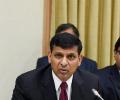
Reserve Bank of India (RBI) Governor Raghuram Rajan has set himself a target of lowering consumer inflation and is even ready to raise rates to achieve it, risking friction with the new government, if he is seen as overstepping.

Foreign brokerage HSBC has said it expects the rupee to trade at 60-levels by December against the dollar even though risks on the domestic unit from both external and domestic fronts have increased.

At the BSE, 1,552 stocks advanced, while 1,419 declined and 118 remained unchanged.

The partially convertible rupee closed at 61.31/32 per dollar, unchanged from its Tuesday close.

The central bank will come out with fresh set of guidelines for companies applying for on-tap bank licence

Sensex to end this year at 27,500 and reach 29,000 by mid 2016.

FY17 GDP growth faces cash crunch heat

The convertibility is RBI Governor's 'next big ambitious goal'.

Domestic investors have managed very well to minimise the impact caused by relentless selling by foreign portfolio investors.

'Every few days, I wake up with a sense of restlessness that time is running out'... 'We have created a due process for stressed assets to resolve, but there is no concrete plan in place for public sector bank balance sheets,' says RBI Deputy Governor Viral Acharya.

The recent agreement between the RBI and the Centre marks a significant step forward toward financial inclusion.

On reforms in pipeline, she said the government is for universal right to minimum wages and wants to remove regional disparity through a national floor wage.

The government could carry out the demonetisation exercise over periodic intervals along with its surprise element, says Soumya Kanti Ghosh.

'MFs have a combined exposure of Rs 3.2 lakh crore to NBFCs, out of which Rs 1.1 lakh crore matures by September 2019.'
 © 2026 Rediff.com - Advertise with us - Disclaimer - Privacy Policy - Sitemap - Feedback - About us - Terms of use - Grievances